.png)
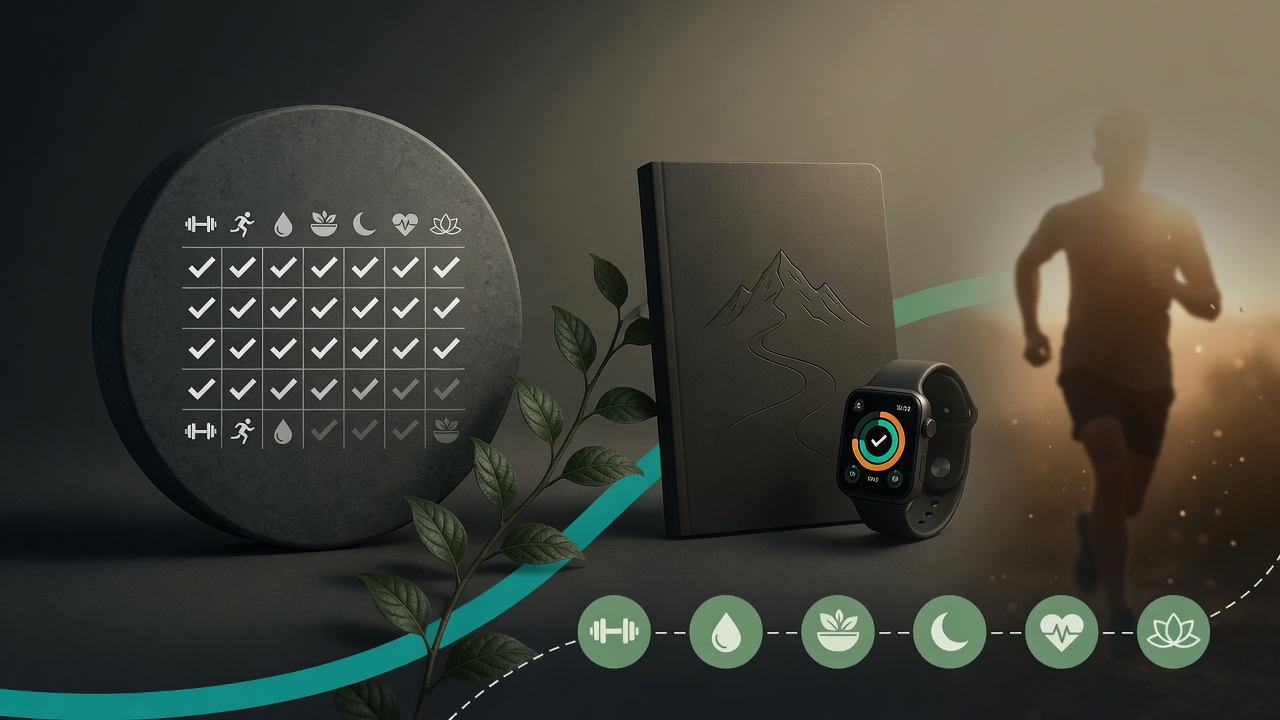
Why habit tracking works (and why most people do it wrong)
The science here is consistent: people who track their behaviors regularly make better decisions, maintain higher consistency, and see measurably better outcomes than those who don't.
But tracking everything creates noise. And noise creates decision fatigue, which is one of the primary reasons people abandon tracking systems within the first few weeks.
The key isn't tracking more. It's tracking the right things: the behaviors that have the highest downstream impact on energy, performance, and progress.
Researchers call these "keystone habits." When they're present, everything else in your health ecosystem tends to improve alongside them. When they're absent, other good habits tend to deteriorate with them.
The habits worth tracking every day
Not all daily behaviors deserve a spot in your tracking system. These five consistently produce the most measurable return.
Sleep
Sleep is the single highest-leverage health behavior available to most adults. It determines recovery quality, hormonal balance, cognitive function, appetite regulation, and how well the body adapts to training stimulus. Tracking sleep, specifically the consistency of timing and rough duration, surfaces patterns that are almost impossible to notice without data. Most people are surprised to discover how variable their sleep actually is until they start looking at it over time.
What to track: bedtime consistency, total hours, and subjective quality on waking.
Daily steps
Steps are the simplest proxy for overall daily movement, and daily movement is a distinct variable from structured exercise. Research consistently links 7,000 to 10,000 daily steps with significant reductions in cardiovascular risk, metabolic dysfunction, and all-cause mortality, independent of gym sessions.
Tracking steps creates awareness of sedentary gaps and builds the low-intensity movement habit that formal training can't fully replace.
What to track: total daily step count, with a consistent personal target.
Protein intake
You don't need to track every macro. But tracking whether you hit an adequate protein target most days is one of the highest-return nutritional habits available, particularly for adults over 35, where muscle protein synthesis becomes less efficient and dietary protein becomes more critical for maintaining lean mass.
What to track: whether you hit your daily protein target, not exact grams every meal.
Water intake
Mild dehydration has a disproportionate effect on energy, cognitive function, and perceived effort during training. Most people chronically underhydrate without realizing it because thirst is a lagging indicator. Tracking water intake, even roughly, consistently improves hydration in people who monitor it versus those who don't.
What to track: total daily fluid intake against a consistent personal target.
Recovery indicators
Subjective recovery, meaning how rested and capable you feel, is one of the most predictive variables for training performance and injury risk. Tracking it daily, even with a simple scale, builds the self-awareness to distinguish productive fatigue from genuine overreaching before the body sends more costly signals.
What to track: a 1 to 5 subjective recovery score each morning, with notes when it's particularly high or low.
The habits most people track but probably shouldn't prioritize
Calories (for most people)
Calorie tracking is useful for specific goals in specific windows. As a daily long-term practice, it correlates with tracking fatigue and an increasingly fraught relationship with food for a significant proportion of people. Unless you have a specific, time-bounded fat loss goal that requires precision, the protein-focused approach above produces better long-term adherence with less cognitive cost.
Detailed workout metrics before the basics are solid
Tracking RPE, volume load, and set-by-set data is valuable at intermediate and advanced levels. For people still building basic consistency, this level of granularity adds friction without adding meaningful signal. Log the workout. Track whether it happened. Add the nuance later.
How to build a tracking system that survives real life
The most common tracking failure isn't lack of motivation. It's a system that's too complex to maintain when life gets difficult. Here's the architecture that holds up.
Start with three behaviors, not ten
Pick the three habits most likely to move the needle for your current goals. For most people, that's sleep, steps, and protein. Get those consistent for 30 days before adding anything else. Adding behaviors one at a time produces dramatically better long-term adherence than attempting a full lifestyle overhaul simultaneously.
Make the tracking moment immediate and specific
Tracking works best when it happens at a fixed point in the day tied to an existing behavior. Morning routines are ideal because the data is fresh and the habit can attach to something already established. "Log my sleep score right after I drink my morning water" is more sustainable than "track my habits sometime today."
Use streaks strategically
Streak data is one of the most powerful behavioral tools in tracking systems. Seeing a 14-day streak creates a specific loss aversion that motivates continuation, particularly on low-motivation days where the streak itself becomes the reason to maintain the behavior. This is most effective when the behaviors being tracked are genuinely achievable on most days, which is another reason to start simple.
Review weekly, not just daily
Daily tracking captures the data. Weekly review is where the insight lives. Spending five minutes on Sunday looking at the previous week's patterns consistently reveals correlations that daily logging alone doesn't surface, including the connection between poor sleep and skipped workouts, or the relationship between high step days and better energy.
How The Fitness League makes this practical
TFL's Trackables feature is built specifically around this framework. Rather than asking users to manage a separate tracking app alongside their training, Trackables brings sleep, steps, water, stress, and recovery into the same dashboard as workouts, so the connections between daily behaviors and training performance become visible in one place.
The streak visualization in TFL is one of the features that drives the most consistent engagement. Seeing your sleep and steps streaks alongside your workout streak creates a unified picture of consistency rather than isolated data points. High-leverage behaviors are visible at a glance, and the system surfaces patterns over time in ways that manual tracking and generic habit apps typically don't.
You can also create custom Trackables for any behavior specific to your goals, making it flexible enough to accommodate the full range of habits worth monitoring without prescribing a rigid framework.
FAQ: Habit tracking for fitness
What should I track for fitness every day? Start with sleep timing, daily steps, and protein intake. These three behaviors have the widest downstream impact on energy, recovery, and body composition. Once those are consistent, add subjective recovery and water intake.
How many habits should I track at once? Research on habit formation consistently points to three as the effective ceiling for building new behaviors simultaneously. More than three creates cognitive load that increases dropout rates. Start with the highest-leverage behaviors and add incrementally.
What are the most important health habits to track daily? Sleep consistency and duration, daily steps, and protein intake are the three with the strongest evidence base for broad health and fitness outcomes. These matter before workout-specific metrics like volume, intensity, or calorie burn.
Does habit tracking actually improve fitness results? Yes, consistently. Studies on self-monitoring behavior show that people who track health behaviors regularly lose more weight, maintain higher training consistency, and report better long-term adherence than those who rely on intention alone. The act of tracking increases awareness, and awareness changes behavior.
What's the difference between logging workouts and tracking habits? Workout logging captures what you did in the gym. Habit tracking captures the behaviors between sessions that determine how well you recover, how consistent you are, and how effectively your training translates into results. Both matter. Most apps only offer one.
How long does it take to build a tracking habit? Habit formation research puts the average at 66 days for a behavior to become automatic, though this varies widely by person and behavior. For tracking specifically, the first two to three weeks are the highest friction point. Simplifying the system and attaching tracking to an existing routine significantly improves the completion rate through this window.
Is it better to track on paper or in an app? Both work. Apps have an advantage in streak visualization, pattern recognition over time, and integration with workout data. Paper has an advantage in simplicity and personalization. The best system is whichever one you'll actually maintain. Start with what creates the least friction.
The bottom line
Habit tracking works when it's simple, consistent, and connected to the behaviors that actually drive your results. The biggest mistake is over-engineering the system before you've established the basics.
Pick your three highest-leverage behaviors. Track them daily. Review weekly. Add complexity only when the foundation is solid.
The data you collect over 60 to 90 days of consistent tracking will tell you more about what's actually driving your results than any program or protocol can predict in advance. That's the real value of habit tracking: not the daily log, but the pattern it reveals over time.
.jpg)
.jpg)